

 One of the most common failure points we see in transformations isn’t strategy, talent, or even technology.
It’s governance.
Not because organizations don’t have governance—but because the governance they have doesn’t work properly. It’s too heavy in some places, nonexistent in others, and unclear almost everywhere.
Most organizations already have some version of a Steering Committee. And most delivery teams already have execution rituals like standups, sprint planning, backlog grooming, and delivery reviews. But there’s a critical layer in the middle that’s usually weak, unclear, or missing entirely.
Ironically, it’s also the layer that often determines whether transformation moves quickly, slows down, or stalls altogether. We call this the Operating Committee, and we’ll dive deeper into why it matters in a moment.
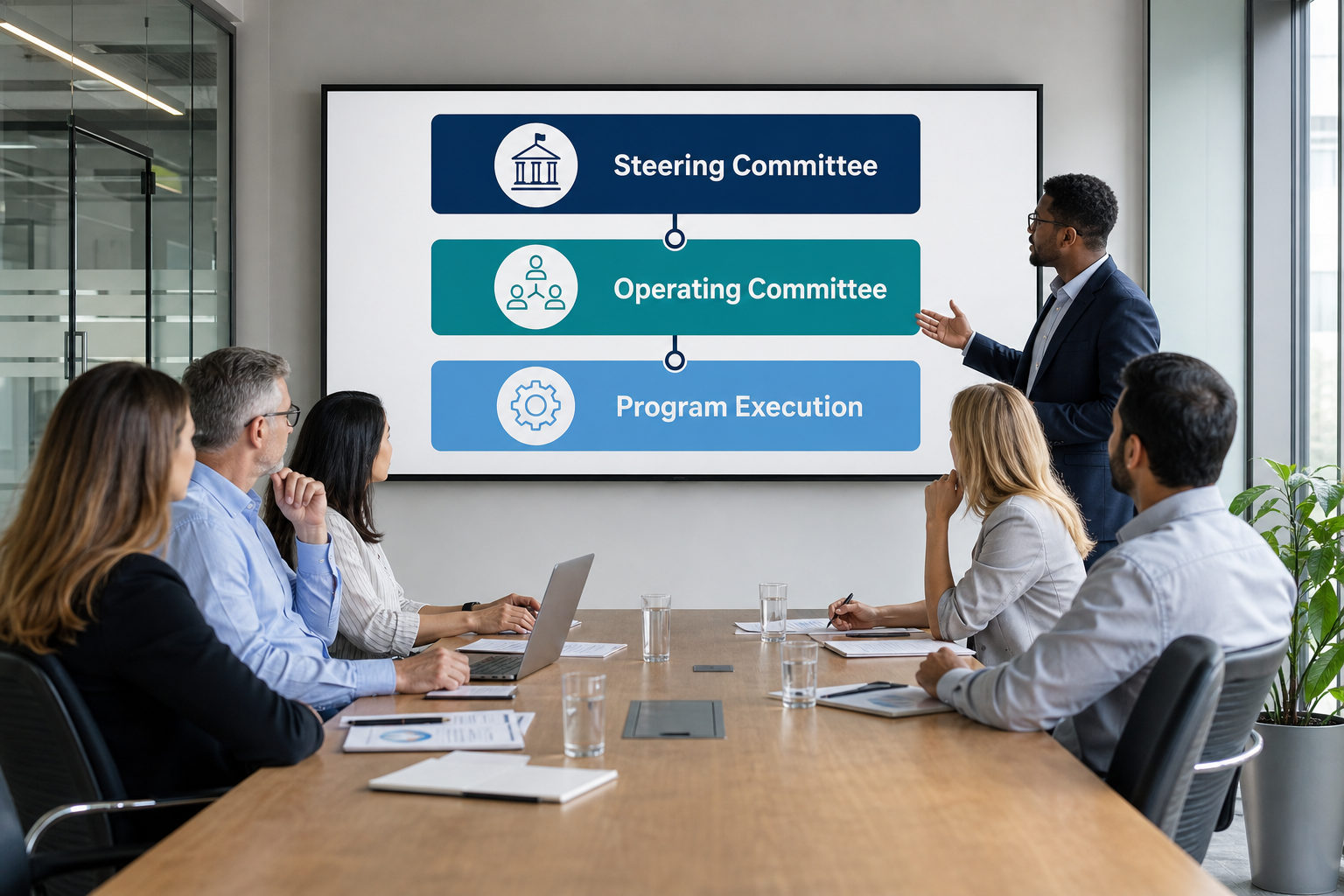
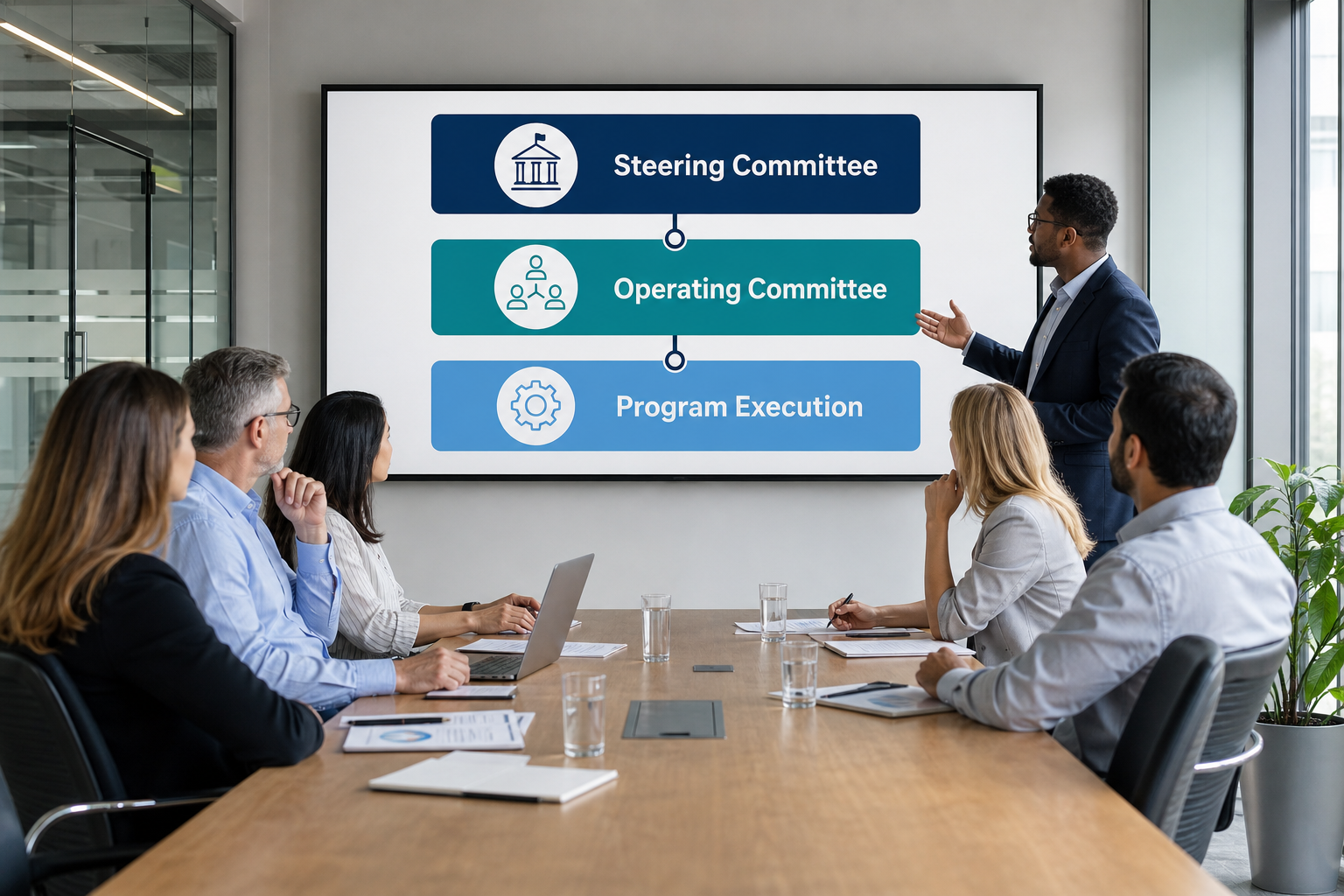
But first, we want to break down the full model: a simple three-tier governance structure that connects business and IT, speeds up decisions, and keeps teams focused on delivering value.
Let’s get into it.
Governance Isn’t About Control. It’s About Flow.
When governance is working, you barely notice it. Work flows through the operating model. Decisions happen at the right level. Teams move quickly with clarity and confidence.
When it’s not, you see the symptoms immediately:
- Too many decisions escalated
- The wrong people making the call
- Bottlenecks and delays
- Frustrated business and IT teams
- Poorly prioritized work
Most organizations swing between two extremes: over-governed (everything needs approval) or under-governed (no one knows who decides what). Neither works.
The goal isn’t more governance. It’s better placement of decisions. That’s where a tiered model comes in.
The Three Tiers of Effective Governance
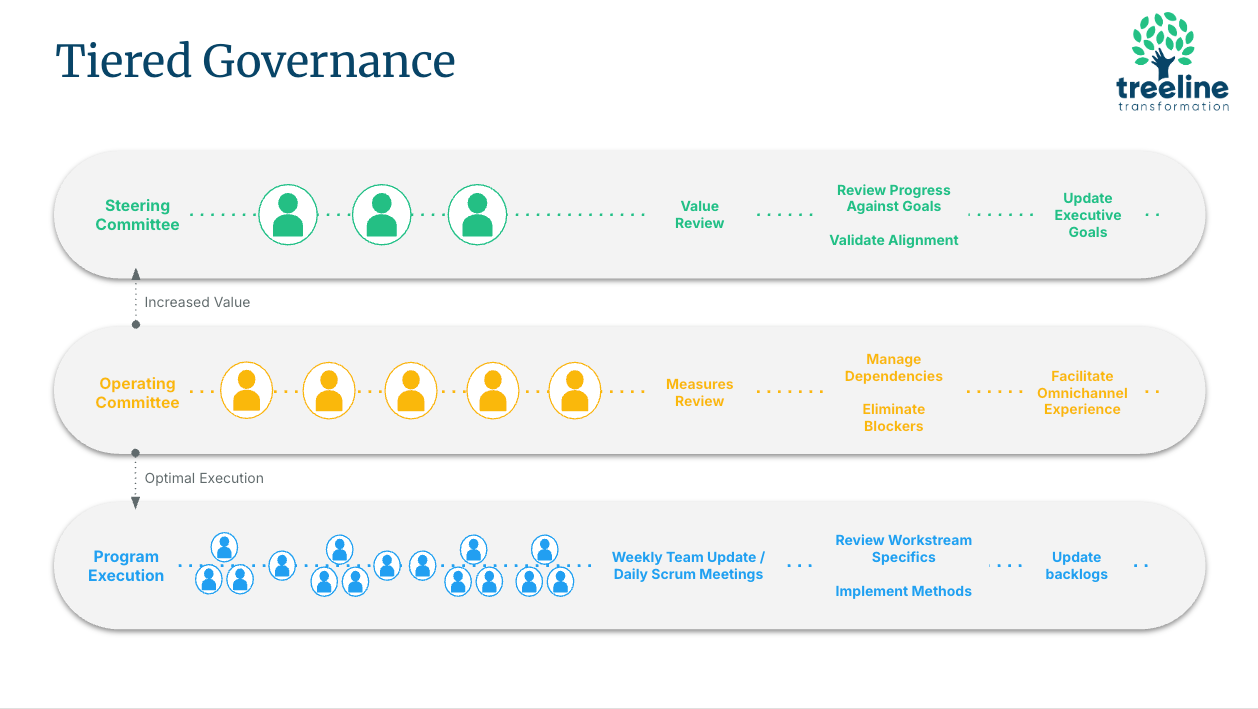
At its core, this model answers a simple question: Where should this decision get made?
One quick note before we break down the model: we’re intentionally covering these layers slightly out of order. Most organizations already understand Steering Committees and delivery teams. The piece that is usually missing (and the part we believe matters most) is the middle layer: the Operating Committee. So we want to build toward that intentionally.
1. Steering Committee: Strategic Alignment
The Steering Committee sits at the top of the governance model.
Its job is not to manage delivery details. It exists to ensure the organization is investing in the right work and removing barriers that teams cannot solve on their own.
Strong Steering Committees:
- Prioritize strategic initiatives
- Approve funding and major investments
- Resolve enterprise-level conflicts
- Align work to business strategy and outcomes
- Remove organizational roadblocks
What they don’t do is micromanage solutions, debate technical implementation details, or review every operational issue.
One of the healthiest signs of a mature governance model is that relatively little work actually needs Steering Committee attention.
2. Program Execution: Value Delivery
At the execution layer, transformation teams, product teams, and delivery teams own the actual work. This is where ideas become user stories, solutions get built, and customer value gets delivered. These teams should operate with a high degree of autonomy inside clear strategic guardrails.
These teams:
- Prioritize sprint and backlog work
- Deliver features and capabilities
- Work directly with business stakeholders
- Iterate and adapt quickly
- Own day-to-day execution decisions
Too many organizations accidentally slow these teams down by escalating operational decisions upward that should stay close to the work. But there’s also another common problem: Teams become isolated from each other.
That’s where the Operating Committee comes in.
3. Operating Committee: Connective Tissue
This is the layer most organizations either don’t have or don’t get right.
The Operating Committee is the connective tissue between strategy and execution. It exists to keep work aligned, visible, and moving across teams. It resolves delivery friction before it becomes executive escalation. It creates coordination without creating bureaucracy.
In healthy organizations, the Operating Committee becomes the operational heartbeat of transformation. This group:
- Resolves cross-team blockers and dependencies
- Coordinates priorities and shared capacity
- Surfaces delivery risks early
- Clarifies what should stay at the team level vs. escalate upward
- Creates visibility across the operating model
- Reinforces consistent ways of working
This layer is the special sauce of this governance model.
Without it, Steering Committees get flooded with tactical issues they should never see, while execution teams struggle in silos without coordination.
The result is predictable: Executives become bottlenecks. Teams become frustrated. Delivery slows down.
But when an Operating Committee is functioning well, teams stay autonomous while the organization stays aligned. That balance is incredibly hard to achieve without this strong middle layer.
What Makes This Model Work
The power of this model is not the meetings themselves.
It’s the clarity.
- Strategic decisions happen in Steering Committee
- Coordination decisions happen in the Operating Committee
- Delivery decisions stay with the teams doing the work
Different decisions. Different forums. Different responsibilities. This separation creates clarity which in turn improves strategic alignment, better decision-making, and flow of work.
Take Action
If governance in your organization feels heavy, unclear, or slow, start by mapping where decisions actually happen today.
Ask:
- What decisions belong with teams but keep getting escalated?
- What issues should be coordinated cross-functionally but currently aren’t?
- What is unnecessarily consuming executive attention?
- Where are dependencies creating delivery friction?
Most organizations don’t need more governance. They need clearer governance—and likely a stronger operational middle layer.
Transformation success is rarely determined by strategy alone. It’s determined by how effectively the organization connects strategy, coordination, and execution.